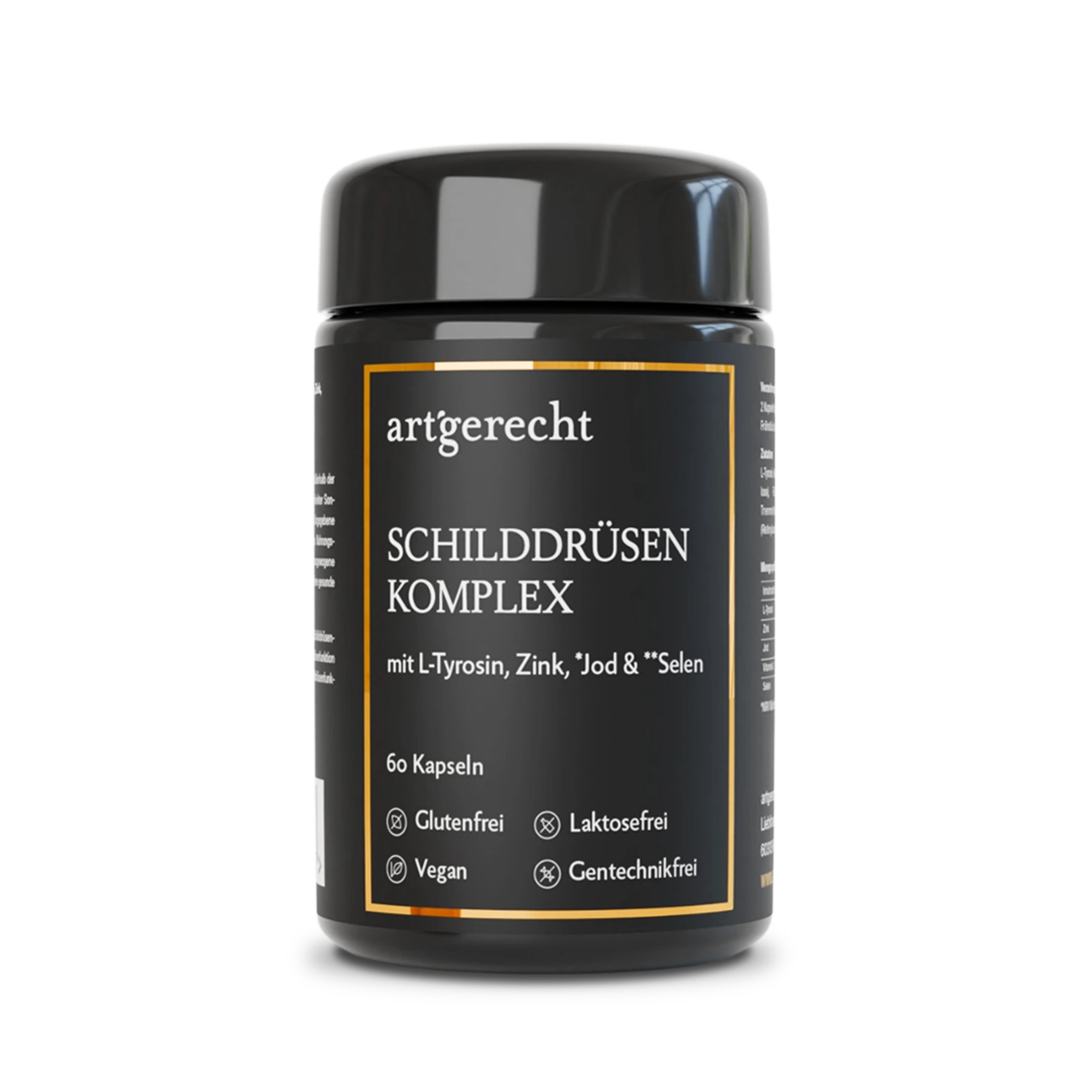
The thyroid is a small organ with a big impact, as it has a considerable influence on our metabolism – and therefore also on the condition of our skin, hair and nails. Through its hormones it controls the metabolism and ensures that we move through life feeling vital. But how exactly does that work?
What does the thyroid do?
Our thyroid gland (Latin: Glandula thyroidea) is closely linked with body temperature, growth, muscle function, reproduction and much more. [1] It is stimulated in the hypothalamus, a part of our diencephalon, via the hormone TSH (Thyroid-Stimulating Hormone) to produce hormones.
The thyroid produces the two hormones L-thyroxine (levothyroxine) and triiodothyronine (liothyronine). These thyroid hormones are better known by their abbreviations T3 (triiodothyronine) and T4 (L-thyroxine):
Formation
- Both hormones contain iodine – T3 has three iodine atoms, whereas T4 has four
- T3 is the active form and T4 is the transport form
- T4 is produced exclusively in the thyroid gland
- T3 and rT3 are formed by splitting off one iodine atom from the transport form T4
- This happens for the most part (approx. 80%) in other parts of the body. The active form of the hormone therefore only exerts its effect in the organ where it is needed
Tasks
- T3 activates metabolism, i.e. it allows muscles and organs to utilise energy
- There is also an antagonist to T3, the so-called rT3 (reverse T3), which has an inhibitory effect and is responsible for the reduction of energy consumption
How can a deficiency of thyroid hormones develop?
A deficiency of thyroid hormones can arise through various mechanisms. For example, the production of T3 requires selenium-containing enzymes. A selenium deficiency can therefore significantly impair T3 production. Liver dysfunction can also lead to changes in thyroid metabolism. In addition to the amino acid L-tyrosine and iodine, the formation of these hormones also requires selenium and other co-factors such as vitamin B3, omega-3 fatty acids, vitamin D and vitamin A. A deficiency of these co-factors can likewise lead to functional disturbances such as underactive thyroid (hypothyroidism) or overactive thyroid (hyperthyroidism).
The best-known thyroid disease caused by a lack of co-factors is goitre. In this condition, a deficiency of iodine leads to a marked enlargement of the thyroid gland. Up into the 1980s, Germany was considered an endemic region for this disease – in other words, it was affected particularly frequently. This changed after iodised table salt was introduced. Today, Germany is no longer an iodine-deficient country. Nevertheless, iodised salt is still widely used by the food industry, for example in baked goods and meat products. A more species-appropriate recommendation for meeting iodine requirements includes sea fish, algae and other iodine-rich foods.
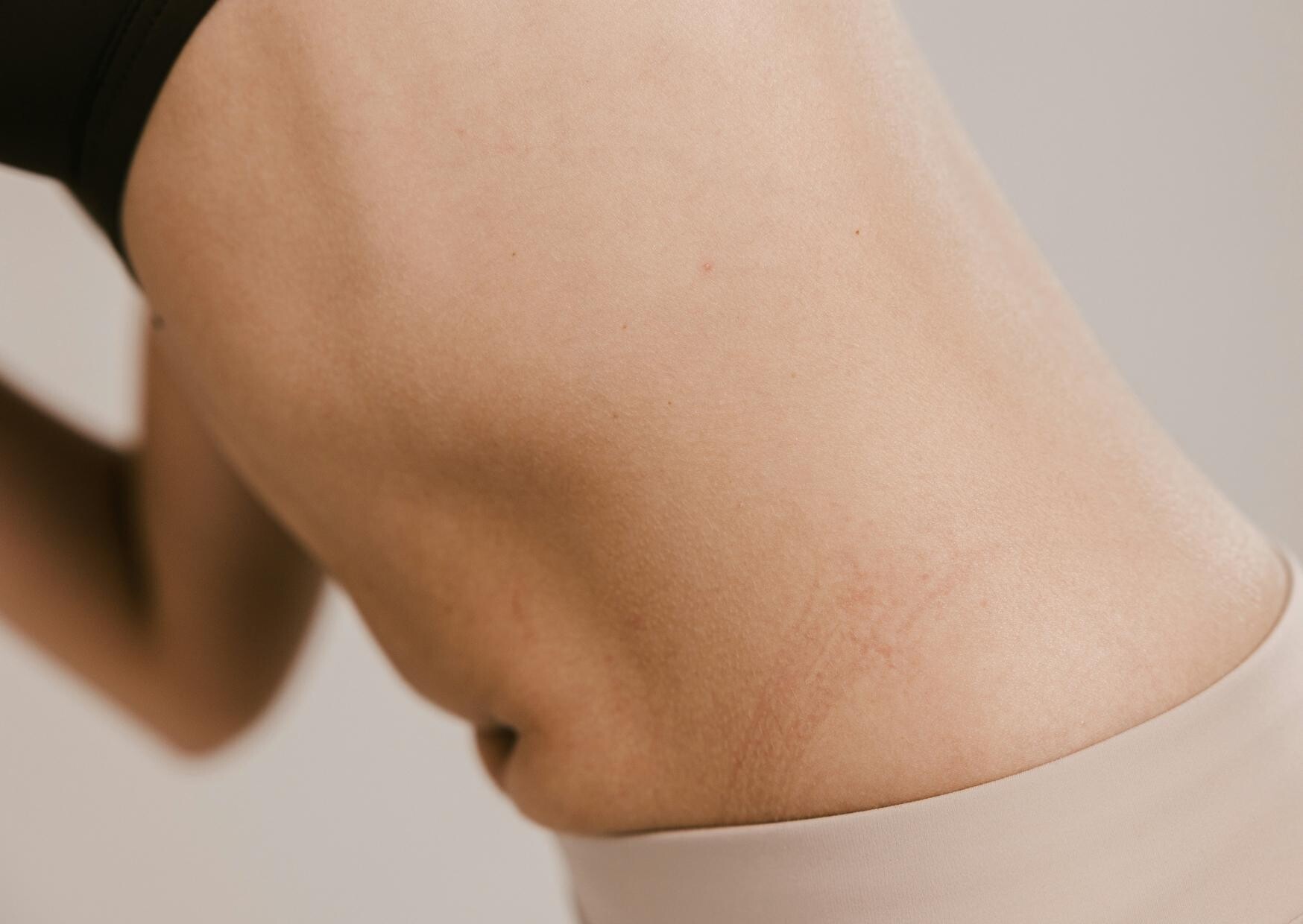
Possible consequences of an underactive thyroid: hair loss, dry skin and brittle nails.
What are the effects of an underactive thyroid?
High levels of the active thyroid hormone T3 mean that we are in a growth, build-up phase. We have beautiful skin, thick hair and strong nails. But if we produce more rT3 than T3, the body switches to an evolutionary “energy-saving mode” because it senses itself to be in danger. With persistently high rT3 levels, our body tries to reduce metabolism more and more. This leads to an underactive thyroid. The metabolism becomes reminiscent of that of a reptile. As a result, we also develop a “reptile-like appearance” [2] with corresponding symptoms: we lose hair, have dry skin and/or brittle nails. We feel cold quickly, get cold hands and feet or find heat very unpleasant. Our ability to regulate body temperature is limited. In addition, fat is stored more easily, since excess weight is also closely associated with an underactive thyroid [3]. Reduced fertility is another common consequence of hypothyroidism. [4] [5] Anyone who notices these changes in themselves should talk to their doctor or therapist. As part of the evaluation, the TSH level in the blood is often measured. If this value is elevated, it may indicate an underactive thyroid that may require treatment.
Activating the thyroid
Everyone can support healthy thyroid function by ensuring an adequate supply of vitamin B3, omega-3 fatty acids, vitamin D and vitamin A. These co-factors assist all important enzymatic processes [6] [7] [8] [9] [10] and thereby also promote healthy-looking skin, hair and nails.
For example, to lose weight, a high production of the thyroid hormone T3 is important. It signals to the body that it is safe to burn fat [3]. To produce this hormone we particularly need iodine, selenium and vitamin B3 – all of which are unfortunately often lacking in modern diets. With a species-appropriate diet, possibly combined with suitable supplementation, this can be specifically addressed.
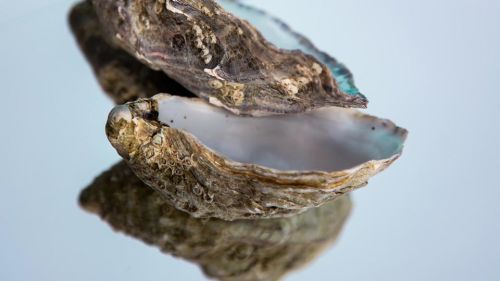
Food as medicine
A species-appropriate diet for humans can support healthy thyroid function. Certain foods provide a good basis for this: for example, a preformed precursor of the thyroid hormone T4 is found in higher amounts in animals that produce it but cannot use it themselves. These include reptiles, insects, amphibians, crustaceans and shellfish. They use the hormone merely as an iodine store [11].
Other foods that can support our thyroid include:
- Algae
- Avocado
- Chilli
- Eggs
- Poultry
- Offal
- Coconut oil and coconut milk
- Sea fish, especially herring and sardines
- Seafood and shellfish
- Mushrooms
- Snails and insects
Foods to avoid in thyroid disorders:
- Bamboo shoots
- Peanuts
- Millet
- Legumes, especially soya
- Potatoes
- Linseed (flaxseed)
- Corn
- Manioc (cassava)
- Horseradish
- Pesticides
- Rapeseed
- Raw cashew nuts
- Raw almonds
- Raw pine nuts
- Raw radishes
- Raw broccoli
- Raw cabbage and other raw cruciferous vegetables
- Mustard
- Sweet potato
- Jerusalem artichoke
Neutralising goitrogens
Goitrogens are thyroid-inhibiting substances that are often found in tuberous plants such as turnips, radishes or potatoes. Heating during cooking converts around 50 percent of all goitrogens after ten minutes. During fermentation (for example of sauerkraut), most of the goitrogenic substances are destroyed within the first few hours. After two weeks at the latest, no goitrogens can be detected any more [12]. If goitrogens are consumed together with iodine-rich foods such as algae, this partly counteracts their effect. [13]
References
- Yen, P. M. (2001). Physiological and molecular basis of thyroid hormone action. Physiological Reviews, 81(3), 1097–1142. https://doi.org/10.1152/physrev.2001.81.3.1097
- Pruimboom, L. (2011). Physical inactivity is a disease synonymous for a non-permissive brain disorder. Medical Hypotheses, 77(5), 708–713. https://doi.org/10.1016/j.mehy.2011.07.022 PM – 21807467 M4 – Citavi
- Sanyal, D., & Raychaudhuri, M. (2016, July 1). Hypothyroidism and obesity: An intriguing link. Indian Journal of Endocrinology and Metabolism. Medknow Publications. https://doi.org/10.4103/2230-8210.183454
- A.M., L., Pearce, E. N., & L.E., B. (2011). Iodine nutrition in pregnancy and lactation. Endocrinology and Metabolism Clinics of North America, 40(4), 765–777. https://doi.org/10.1016/j.ecl.2011.08.001 PM – 22108279 M4 – Citavi
- Perez-Lopez, F. R. (2007). Iodine and thyroid hormones during pregnancy and postpartum. Gynecological Endocrinology, 23(7), 414–428. https://doi.org/10.1080/09513590701464092 PM – 17701774 M4 – Citavi
- Selenium and thyroid disease: From pathophysiology to treatment. (n.d.). Retrieved 19 May 2020, from https://www.ncbi.nlm.nih.gov/pmc/articles/PMC5307254/
- Foley, T. P. (1992). The relationship between autoimmune thyroid diseas… [Endokrynol Pol. 1992] – PubMed result. Endokrynologia Polska, 43 Suppl 1, 53–69. Retrieved from http://www.ncbi.nlm.nih.gov/pubmed/1345585
- Chung, H. R. (2014). Iodine and thyroid function. Annals of Pediatric Endocrinology & Metabolism, 19(1), 8. https://doi.org/10.6065/apem.2014.19.1.8
- Farhangi, M. A., Keshavarz, S. A., Eshraghian, M., Ostadrahimi, A., & Saboor-Yaraghi, A. A. (2012). The effect of vitamin A supplementation on thyroid function in premenopausal women. Journal of the American College of Nutrition, 31(4), 268–274. Retrieved from http://www.ncbi.nlm.nih.gov/pubmed/23378454
- Soliman, A. T., De Sanctis, V., Yassin, M., Wagdy, M., & Soliman, N. (2017). Chronic anemia and thyroid function. Acta Biomedica, 88(1), 119–127. https://doi.org/10.23750/abm.v88i1.6048
- Sanyal, D., & Raychaudhuri, M. (2016, July 1). Hypothyroidism and obesity: An intriguing link. Indian Journal of Endocrinology and Metabolism. Medknow Publications. https://doi.org/10.4103/2230-8210.183454
- Eales, J. G. (1997). Iodine metabolism and thyroid-related functions in organisms lacking thyroid follicles: Are thyroid hormones also vitamins? Experimental Biology and Medicine, 214(4), 302–317. https://doi.org/10.3181/00379727-214-44098
- The change of thiocyanate (goitrogen) amount, indolylmethyl glucosinolate content and myrosinase activity in radish kimchi during fermentation – Korean Journal of Food and Cookery Science | Korea Science. (n.d.). Retrieved 19 May 2020, from http://www.koreascience.or.kr/article/JAKO198911921377658.page
- Gaitan, E. (1990). Goitrogens in food and water. Retrieved from www.annualreviews.org