
-
 DE
DE



Complement Consumption – Definition & Clinical Significance
Complement consumption refers to the activation and depletion of complement proteins in the blood. It is a key marker in autoimmune diseases and severe infections.
Things worth knowing about "Complement consumption"
Complement consumption refers to the activation and depletion of complement proteins in the blood. It is a key marker in autoimmune diseases and severe infections.
What is Complement Consumption?
Complement consumption refers to the process by which proteins of the complement system – a critical part of the innate immune system – are activated and subsequently depleted. The complement system comprises more than 30 plasma proteins that play a central role in defending against pathogens and mediating inflammatory responses. When these proteins are activated on a large scale, their concentration in the blood measurably decreases – a state referred to as complement consumption or complement depletion.
The Complement System: Basics
The complement system can be activated via three distinct pathways:
- Classical pathway: Triggered by antigen-antibody complexes (immune complexes)
- Lectin pathway: Activated by carbohydrate structures on the surface of pathogens
- Alternative pathway: Spontaneously activated by foreign surfaces
Each activation cascade results in the cleavage and processing of complement proteins, ultimately leading to pathogen destruction, promotion of inflammation, and opsonization – the marking of foreign particles for uptake by immune cells (phagocytosis).
Causes of Complement Consumption
Increased complement consumption occurs when the immune system is strongly activated. Common causes include:
- Autoimmune diseases: Especially Systemic Lupus Erythematosus (SLE) and other conditions characterized by immune complex formation
- Infections: Severe bacterial or viral infections can place significant demands on the complement system
- Hemolytic Uremic Syndrome (HUS): A condition associated with uncontrolled complement activation
- Cryoglobulinemia: Deposition of cold-sensitive immunoglobulins that form immune complexes
- Membranoproliferative Glomerulonephritis (MPGN): A kidney disease with persistent complement activation
- Hereditary Angioedema: Genetically determined complement deficiency with recurrent episodes
Diagnosis: Measuring Complement Consumption
Complement consumption is assessed through blood tests measuring specific complement factors. The most commonly used laboratory parameters include:
- C3 and C4: The most frequently measured individual factors. Decreased levels indicate active consumption.
- CH50 (Total Hemolytic Complement Activity): A functional assay that measures the overall activity of the classical complement pathway.
A combined decrease in C3 and C4, together with clinical symptoms, provides important evidence of active autoimmune disease such as SLE. An isolated reduction in C4 may also suggest a genetic C4 deficiency.
Clinical Relevance
Detecting complement consumption helps clinicians assess disease activity, adjust therapy, and monitor disease progression over time. In patients with SLE, complement levels are monitored regularly, as declining values may signal an impending disease flare. Complement diagnostics also play a central role in identifying rare complement-associated disorders such as paroxysmal nocturnal hemoglobinuria (PNH) and atypical HUS.
Treatment
Treatment of complement consumption is directed at the underlying condition:
- Autoimmune diseases: Immunosuppressive therapy (e.g., corticosteroids, hydroxychloroquine, azathioprine) to reduce immune complex formation
- Complement inhibitors: In diseases such as atypical HUS or PNH, targeted medications such as eculizumab are used to directly inhibit complement activation
- Treatment of infection: Antibiotics or antiviral agents in cases of infection-driven complement consumption
References
- Walport, M. J. - Complement. First of two parts. New England Journal of Medicine, 344(14), 1058–1066 (2001). DOI: 10.1056/NEJM200104053441406
- Mayadas, T. N., Tsokos, G. C., Tsuboi, N. - Mechanisms of immune complex-mediated neutrophil recruitment and tissue injury. Circulation, 120(20), 2012–2024 (2009).
- Schifferli, J. A., Ng, Y. C., Peters, D. K. - The role of complement and its receptor in the elimination of immune complexes. New England Journal of Medicine, 315(8), 488–495 (1986).

Building Blocks for a Healthy Life
As an integrated manufacturer, we develop & produce evidence-based, patented, and non-patented formulations. We work exclusively with plant and natural extracts according to the strictest purity & quality standards.
The combination of science & modern technology with the laws of nature creates solutions consistently tailored to humans – for the highest good: health.
Verwandte Produkte
Subscription available

Floral
For Healthy Oral Flora & Dental Care
Formulated lozenges with Dentalac®, lactic acid bacteria, and Lactoferrin CLN®30 lozenges
Regular price:
€22.90
Subscription available
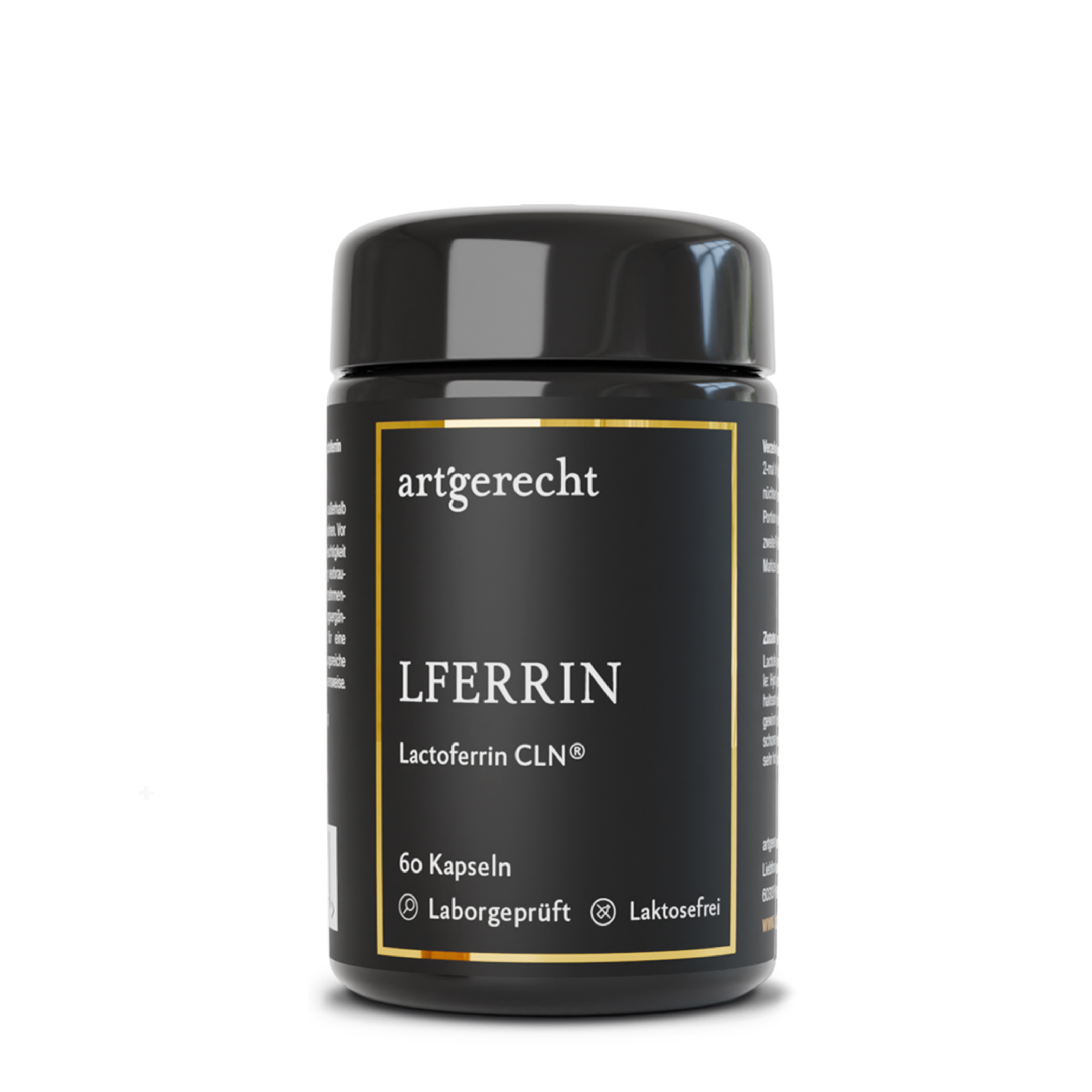
Lactoferrin
For your universal protection
As one of the most valuable proteins in the body, lactoferrin is a natural component of the immune system.[siehe Varianten]
Regular price:
€59.90
Subscription available

Natural Iron

For your iron balance
Specially formulated for your iron balance with plant-based curry leaf iron, Lactoferrin CLN®, and natural Vitamin C from rose hips.
30 Capsules
Regular price:
€35.90
Most read entries
3 Posts in this encyclopedia categoryMagnesiumcarbonat
Magnesiumcarbonat ist eine anorganische Magnesiumverbindung mit säure-neutralisierender (antazidischer) Wirkung. Erfahre mehr über Vorteile, Einsatzgebiete und Unterschiede zu besser resorbierbaren Magnesiumformen.
Calorie content
The choice of food influences our energy intake. The calorie content varies greatly - some provide little energy, others a lot.
Cologne list
The Cologne List ® is an important initiative in competitive sports that offers athletes guidance in the selection of nutritional supplements.