


Entropy – Meaning in Medicine and Biology
Entropy is a fundamental concept in thermodynamics describing the degree of disorder in a system. In medicine, it plays a role in cellular processes, metabolism, and aging.
Things worth knowing about "Entropy"
Entropy is a fundamental concept in thermodynamics describing the degree of disorder in a system. In medicine, it plays a role in cellular processes, metabolism, and aging.
What is Entropy?
Entropy is a central concept from thermodynamics and physics that describes the degree of disorder or randomness within a system. The higher the entropy, the more disordered the state of the system. The concept was introduced in the 19th century by Rudolf Clausius and has since become a foundational principle in natural sciences and medicine.
In biology and medicine, entropy is particularly relevant because living organisms must constantly work against the natural tendency toward disorder. Living cells are highly ordered structures that continuously require energy to maintain their organization.
Thermodynamic Foundations
In classical thermodynamics, entropy describes how much energy within a system is no longer available to perform useful work. The Second Law of Thermodynamics states that the entropy of a closed system always increases or remains constant – it can never spontaneously decrease. This means that natural processes always proceed in the direction of greater disorder.
- Low entropy: High order, lower probability of the state
- High entropy: High disorder, greater probability of the state
Entropy in Biology and Medicine
Cellular Processes
Living cells are thermodynamically open systems that constantly exchange energy and matter with their surroundings. By consuming energy – primarily in the form of ATP (adenosine triphosphate) – biological systems can maintain and even increase their internal order while releasing entropy to the environment.
Metabolism and Energy Production
Metabolism is fundamentally a process through which the body uses nutritional energy to manage entropy. Biochemical reactions such as cellular respiration convert chemical energy into usable energy, releasing entropy in the form of heat to the surroundings.
Aging and Entropy
The concept of entropy is frequently discussed in relation to the biological aging process. With increasing age, damage accumulates in DNA, cell repair mechanisms become less efficient, and molecular order within cells diminishes. Some scientists describe aging as a form of increasing biological entropy:
- Accumulation of DNA damage
- Protein misfolding
- Degradation of cell organelles
- Declining mitochondrial function
Entropy in Information Theory and Medicine
In modern medicine, the concept of information entropy (based on Claude Shannon) is increasingly applied, for example in the analysis of heart rate variability, brain waves (EEG), and biological signal patterns. Increased entropy in physiological signals can indicate health and adaptability, while very low entropy may suggest rigidity and disease.
Clinical Relevance
Understanding entropy is significant in several medical fields:
- Cardiology: Analysis of heart rate variability (HRV) using entropy measures to assess the autonomic nervous system
- Neurology: Measurement of brain activity and states of consciousness through EEG entropy
- Pharmacology: Thermodynamic principles determine how drugs bind to receptors and exert their effects
- Biochemistry: Entropy influences protein folding and the structure of cell membranes
References
- Clausius, R. (1865). On the Different Forms of the Fundamental Equations of the Mechanical Theory of Heat. Annalen der Physik und Chemie, 201(7), 353–400.
- Goldberger, A. L. et al. (2002). Fractal dynamics in physiology: alterations with disease and aging. Proceedings of the National Academy of Sciences, 99(Suppl 1), 2466–2472. PubMed PMID: 11875196.
- Schrödinger, E. (1944). What is Life? The Physical Aspect of the Living Cell. Cambridge University Press.

Building Blocks for a Healthy Life
As an integrated manufacturer, we develop & produce evidence-based, patented, and non-patented formulations. We work exclusively with plant and natural extracts according to the strictest purity & quality standards.
The combination of science & modern technology with the laws of nature creates solutions consistently tailored to humans – for the highest good: health.
Verwandte Produkte

For Healthy Oral Flora & Dental Care
Formulated lozenges with Dentalac®, lactic acid bacteria, and Lactoferrin CLN®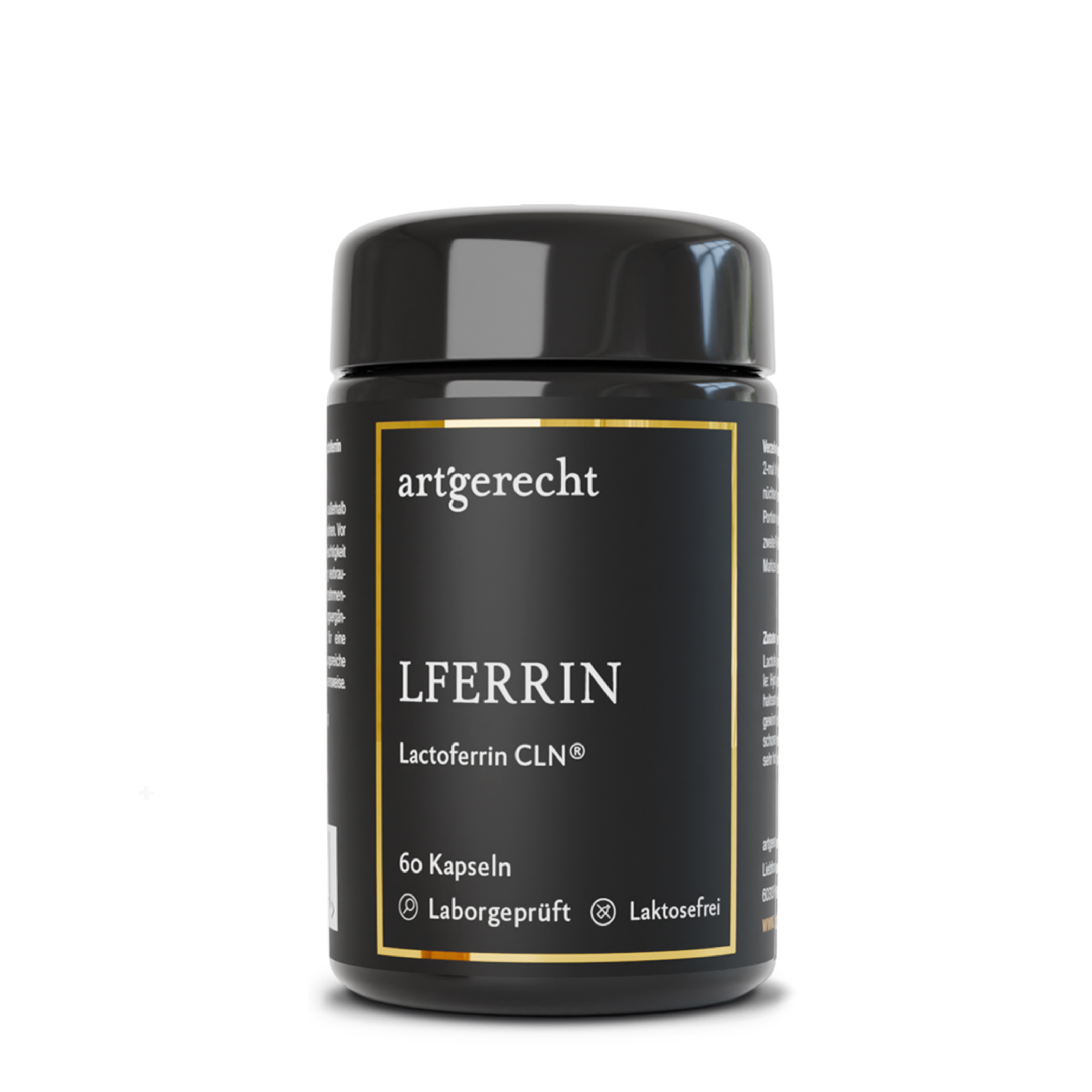
For your universal protection
As one of the most valuable proteins in the body, lactoferrin is a natural component of the immune system.
For your iron balance
Specially formulated for your iron balance with plant-based curry leaf iron, Lactoferrin CLN®, and natural Vitamin C from rose hips.